How to Fix Cloudy Pool Water
Find out why your pool is cloudy and fix it in the right order: filter, chlorine, pH and alkalinity, then clarifier or flocculant. Includes a cause chart.
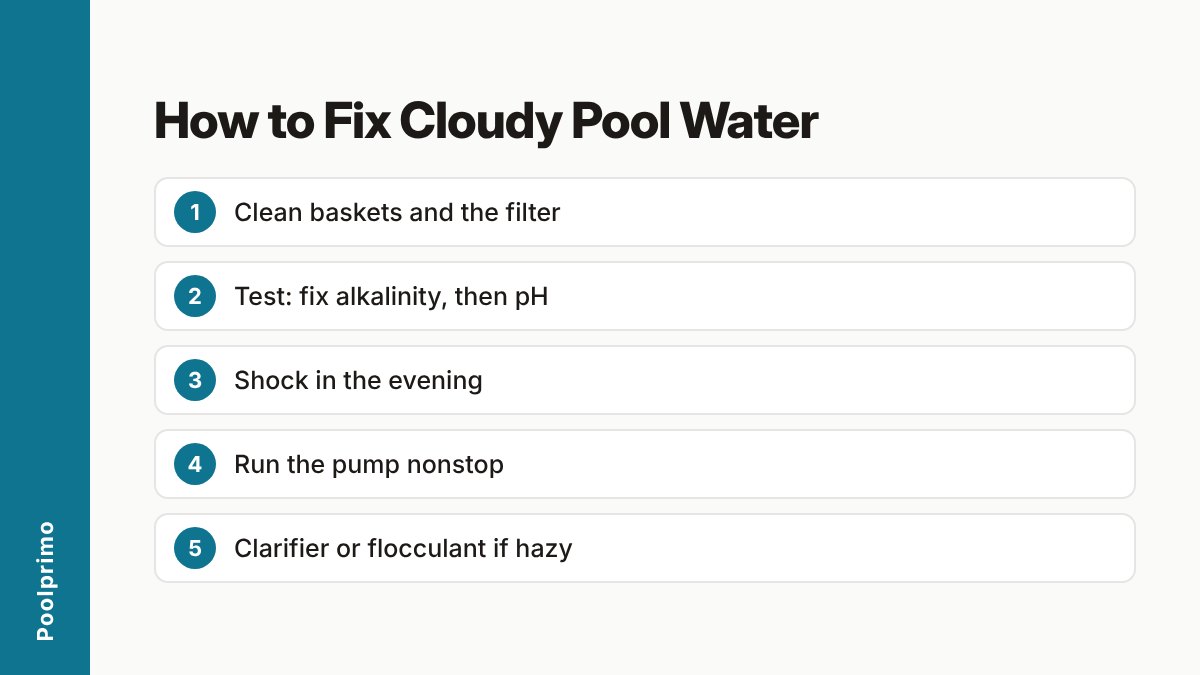
Cloudy pool water usually comes down to three things: a filter that is not catching fine particles, sanitizer that is too low, or water chemistry that is out of balance. Fix them in that order, test, and only then reach for a clarifier or flocculant to finish the job.
Quick answer
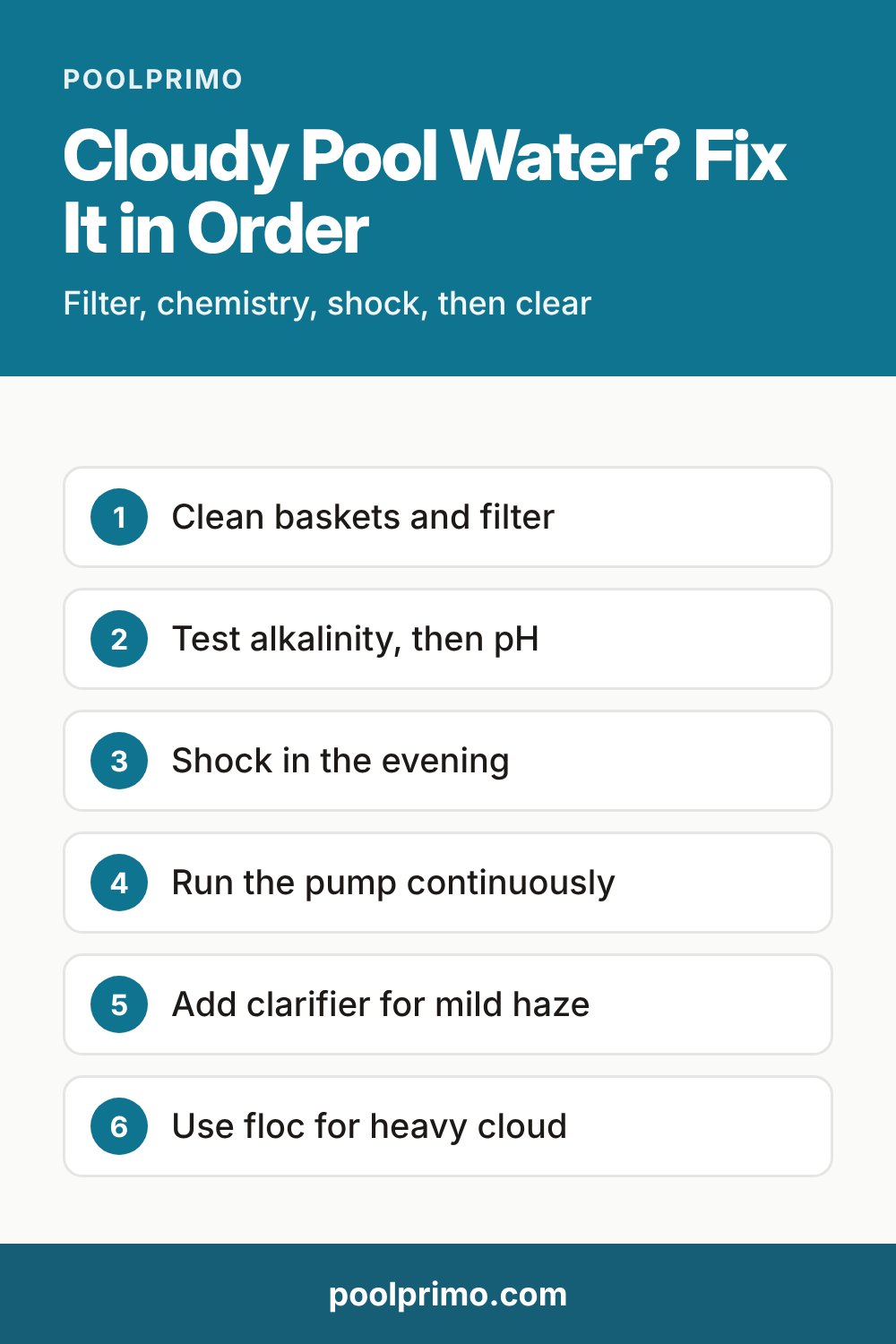
- Clean the skimmer and pump baskets, then clean or backwash the filter.
- Test the water. Correct total alkalinity first, then pH.
- Raise free chlorine, or shock the pool in the evening.
- Run the pump around the clock until the water clears.
- If it is still hazy, add a clarifier (mild haze) or a flocculant (heavy cloudiness).
What causes cloudy pool water
Cloudiness is just tiny particles suspended in the water. The table shows the usual suspects and what to do about each.
| Likely cause | What it looks like | Fix |
|---|---|---|
| Dirty or worn filter, short run time | Dull water, poor flow, high gauge pressure | Clean the filter and baskets, run the pump longer |
| Low free chlorine | Dull, hazy water that may turn green | Test, then add chlorine or shock |
| High pH or alkalinity | Fine white haze, scale on tile or surfaces | Lower alkalinity first, then pH |
| Debris, pollen, storm runoff | Haze after wind, rain or a busy swim day | Skim, brush, vacuum, then filter |
| Early algae | Water looks dull before turning green | Brush, shock, run the filter |
| Sunscreen, oils, swimmer waste | Haze after heavy use | Shock, then keep the filter running |
What you need
- A reliable test kit or test strips that read free chlorine, pH and total alkalinity.
- Pool chlorine or shock, plus pH and alkalinity adjusters (acid-based products to lower, soda-type products to raise).
- A pool brush and a manual vacuum.
- A clarifier or flocculant, only if the steps below call for it.
- Gloves and eye protection for handling chemicals.
Ideal ranges to test against
Ranges vary slightly between sources, so always check the label of your chemicals and any guidance for your pool type. One county health department guide lists these ideal readings for pool water:
| Test | Ideal range |
|---|---|
| Free chlorine | 2.0 to 4.0 ppm (never below 1 ppm while the pool is in use) |
| pH | 7.4 to 7.6 (chlorine works well between 7.2 and 7.8) |
| Total alkalinity | 80 to 120 ppm |
| Cyanuric acid (stabilizer) | 30 to 50 ppm |
| Combined chlorine | None |
Other pool-care sources suggest slightly different targets, for example free chlorine of 1 to 3 ppm or alkalinity somewhat higher for some pool types. If your pool has a manufacturer or installer target, use that. Cyanuric acid above about 70 ppm can stop chlorine from disinfecting properly, so a very high reading is a clue when chlorine seems to do nothing.
Step-by-step: fix cloudy water in the right order
1. Clean the filter and baskets
A clogged filter is the most common reason water will not clear. Empty the skimmer and pump baskets, then clean the filter media. Backwash a sand filter or rinse a cartridge according to its manual. One guide suggests cleaning or backwashing when pressure runs well above normal, and notes that worn sand media (about 5 years old) or cartridges (roughly 2 to 3 years) may no longer trap fine particles. Check your own gauge: note the clean-start pressure and act when it climbs noticeably.
2. Brush and vacuum
Skim the surface, brush the walls and floor so settled dirt goes back into suspension, and vacuum. If you see algae, vacuum to waste (the multiport valve’s Waste setting, or the filter’s drain port) so the dirt does not pass through the filter and return to the pool. Keep a hose topping up the water while you do.
3. Test and balance, alkalinity first
Test free chlorine, pH and total alkalinity. If alkalinity is high, correct it before pH, because alkalinity affects how stable pH is. Chemistry guides commonly suggest adjusting alkalinity, then pH, then calcium hardness. Add chemicals in small doses with the pump running, wait for them to circulate, and retest rather than guessing.
4. Raise chlorine or shock
Low sanitizer lets contaminants and early algae build up. If chlorine is low, or the water is hazy after heavy use or storms, shock the pool following the product label. Do it in the evening so sunlight does not burn off the chlorine, and run the filter overnight (at least 8 hours). Do not swim until free chlorine drops back into the range on the label or in your guidance, and retest.
5. Run the filter continuously
Normal pump run time for many pools is 8 to 12 hours a day, but while clearing cloudy water, run it continuously until the haze is gone. Aim the return jets downward at an angle (around 45 degrees) to improve circulation if dead spots are an issue.
6. Add a clarifier or flocculant if needed
If the chemistry is balanced, the filter is clean and the water is still hazy, use one of these.
| Clarifier | Flocculant (floc) | |
|---|---|---|
| Best for | Mild cloudiness | Very cloudy water |
| How it works | Binds fine particles into clumps the filter can catch | Clumps particles so they sink to the floor |
| Filter | Runs continuously | Pump is turned off while particles settle |
| Effort | Low | Higher, needs manual vacuuming |
| Typical clearing time | Around 2 to 3 days | Often faster, around 1 to 2 days |
Using a clarifier: Balance the water first, add the product per the label (often diluted and poured around the edge or into the skimmer), and keep the filter running. Avoid backwashing for about a day so the clumps stay in the filter, then clean it afterward. If there is no improvement after about 48 hours, check the filter again.
Using a flocculant:
- Set pH to the product’s recommended range first.
- Add the dose from the label with the pump running.
- Circulate for about 2 hours, ideally with the filter bypassed (recirculate mode).
- Turn the pump off for 8 to 12 hours so the particles settle on the floor, and make sure a timer does not restart it.
- Vacuum slowly to waste, not through the filter, and keep the pool topped up with a hose.
- Retest, rebalance, restore chlorine and return to normal run times.
If you cannot vacuum to waste, flocculant is a poor choice. Use a clarifier instead.
Common mistakes
- Adding clarifier first. It cannot fix low chlorine, bad balance or a dirty filter.
- Changing pH before alkalinity. High alkalinity pushes pH back up.
- Dumping in lots of chemicals at once. Add in stages and retest.
- Vacuuming flocculated debris through the filter. It returns most of the cloud to the pool.
- Shocking in bright sun. Sunlight breaks chlorine down quickly; shock in the evening.
- Letting the timer shut the pump off during clearing. Continuous filtration is the point.
Preventing it from coming back
- Test the water regularly, and more often after storms, heat or heavy use.
- Run the pump for enough hours each day and keep baskets empty.
- Clean the filter on a schedule rather than waiting for problems.
- Keep sunscreen and body oils down by rinsing before swimming, where possible.
- Shock on a routine appropriate for your pool and climate.
In Australia, where it is summer now, higher temperatures and heavy use increase chlorine demand, so cloudy water can show up faster. In the northern hemisphere, the same causes apply, but cloudiness is often seen at spring opening, when the pool has been sitting with a cover on.
When to call a professional
- Water stays cloudy after the filter is clean, the chemistry is in range and you have run a full clarifier cycle.
- Filter pressure stays high or flow is weak after cleaning, which may point to pump or plumbing faults.
- You cannot get readings into range, or you suspect very high stabilizer, which usually means partial draining.
- You are unsure about handling or mixing pool chemicals. Never mix different chlorine products together.
Sources
Frequently asked questions
How long does cloudy pool water take to clear?
It depends on the cause and the method. A clarifier commonly takes 2 to 3 days with the filter running, while a flocculant can work faster but needs a settle-and-vacuum routine. If the water is not improving after about 48 hours, check the filter.
Is it safe to swim in a cloudy pool?
Health guidance says a pool should only be used when the water is clear enough to see the bottom. Cloudy water can also mean low sanitizer, so wait until it is clear and tests in range.
Should I use a clarifier or a flocculant?
Use a clarifier for mild haze when the chemistry is balanced and the filter is working. Use a flocculant for very cloudy water, but only if you can vacuum to waste or you have another way to remove the settled debris.
Why is my pool cloudy even though the chlorine is fine?
Chlorine is only one part. Fine particles that the filter misses, high pH or alkalinity that makes calcium cloud the water, or a tired filter can all cause haze with normal chlorine.